
The Mind Is the Enemy
A Buddhist Teaching For The Colonized Mind

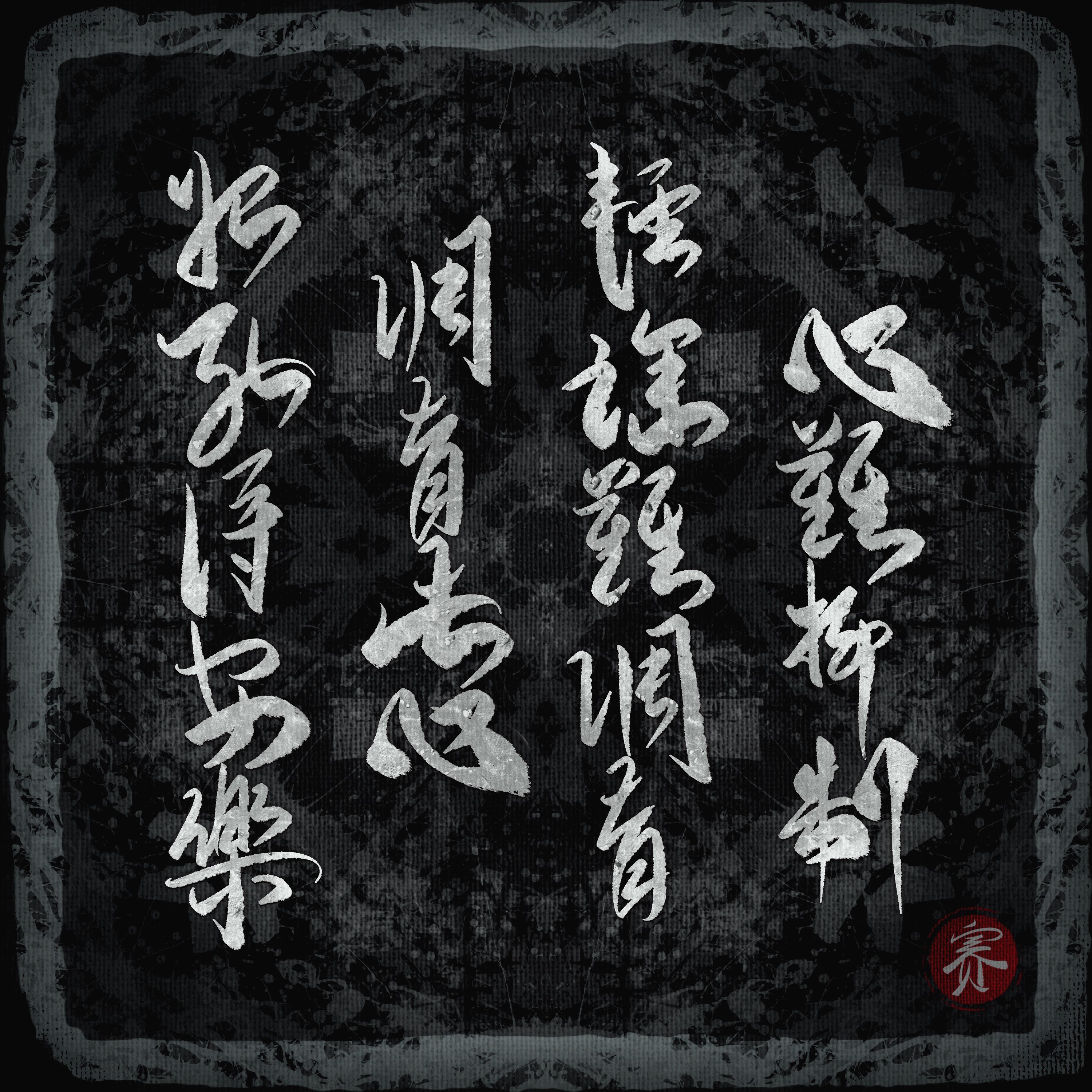
“It is a man’s own mind, not his enemy or foe, that lures him into evil ways.”
— The Teaching of Buddha, Bukkyō Dendō Kyōkai
I was reading The Teaching of Buddha yesterday. I opened the book to a random page and just started reading. The book is a compilation published by Bukkyo Dendō Kyōkai, organized into short passages that read as discrete thoughts. Its Japanese title is Bukkyō Seiten, literally "Buddhist sacred scripture," and it has been widely known in English as a "Buddhist Bible." This time, I landed on a section called Sacred Sayings, a short cluster of verses almost all of which are about the mind. One of them stopped me: "It is a man's own mind, not his enemy or foe, that lures him into evil ways." A few lines down, in the same cluster, another saying made me stop again. It said the mind is hard to restrain, flighty, and difficult to tame, and that taming this mind is what allows a person to reach peace.
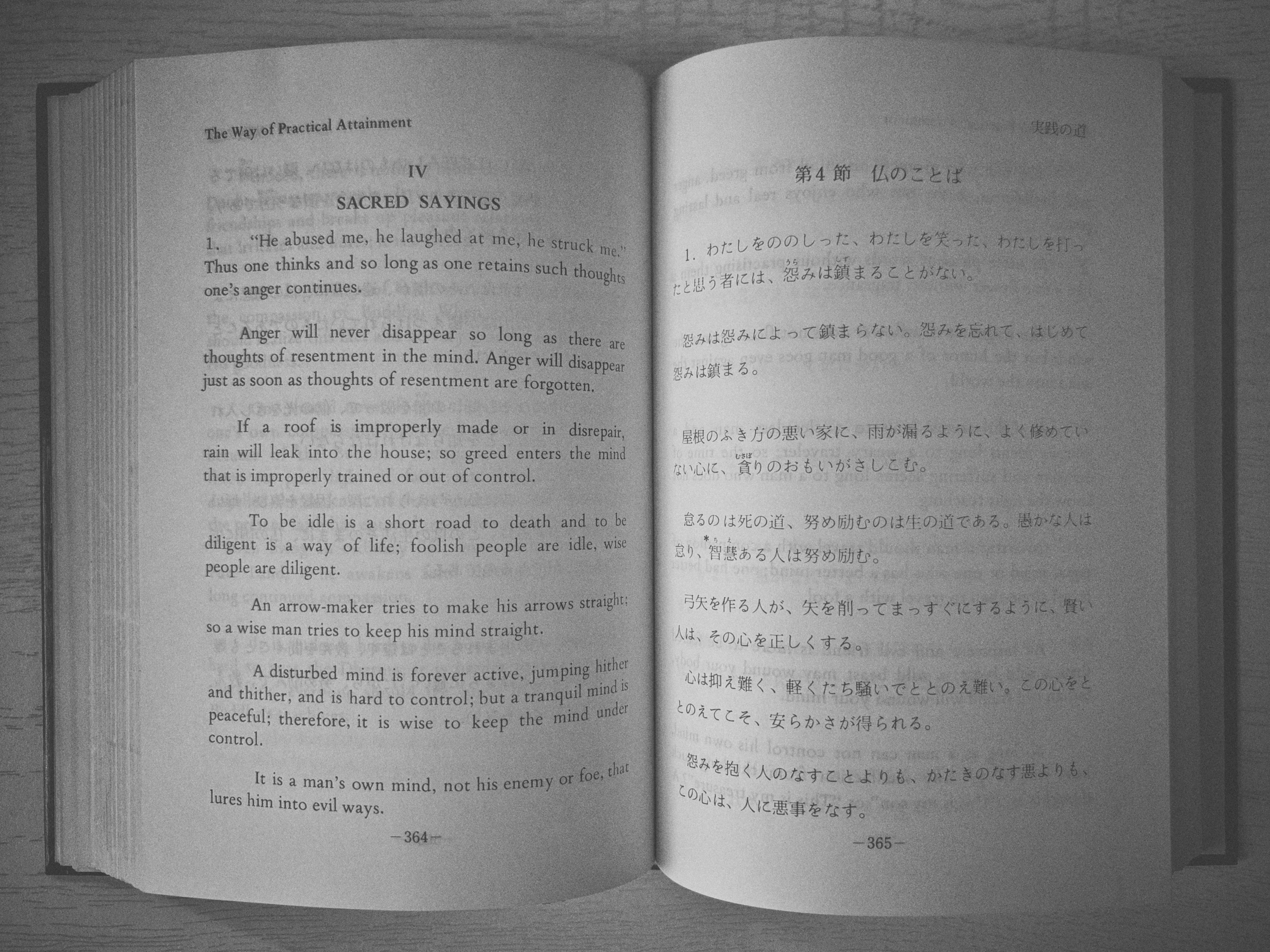
The Teaching of Buddha, open to the Sacred Sayings
The verses in Sacred Sayings are drawn from older Buddhist scripture, so I went to the Dhammapada to find the source. The verse on the restless mind traces back there, where it stands as verse 35. The version I would eventually paint, though, was the Chinese one printed in The Teaching of Buddha itself. I usually write my essays first and make the calligraphy piece afterward. This time I made the calligraphy first. Afterwards the verse kept running through my mind, so I decided to write about it.
What the verse asks the reader to accept is a claim that sounds, on first hearing, almost cruel. Your own mind is what leads you into difficulty. The cause is not other people, not hostile circumstances, not systemic forces, and not bad luck. The cause is your own mind. The second verse softens the cruelty slightly by admitting that the mind is not an easy thing to govern. It is flighty and distractible and resistant to restraint. It jumps from one stimulus to the next. It craves pleasant sensations and recoils from unpleasant ones. It generates stories about what is happening that often have very little to do with what is actually happening. Because most people never train it, most people spend their lives being dragged around by it without noticing that this is happening. It is tempting to say that such a person is not really making choices, but that is not quite right, and the imprecision matters. A person is always making choices. To react is a choice, to submit to an impulse is a choice, to do what the old pattern demands is a choice, even when it does not feel like a choice at all. The problem is not that choice is absent. The problem is that awareness is absent. The choosing happens beneath conscious attention, so quickly and so habitually that it is never experienced as a decision, and the person is left with the sincere conviction that they had no other option. The options were there, but they went unseen. An untrained mind does not take your freedom away. It hides your freedom from you, and a freedom you cannot see is a freedom you cannot use.
This is also where a deeper danger begins. A mind that chooses without knowing it is choosing can be steered, and it can be steered precisely because the choosing is unconscious. Anything that learns how your unexamined patterns work can trigger them on purpose, and when it does, you carry out the reaction and experience it as your own. The manipulation never has to reach in and force anything. It only has to know which patterns are already there and supply the trigger. This is why the unaware mind is the vulnerable mind. The less of your own choosing you can see, the more of it can be done for you by something outside you, while you stay convinced that you are the author of everything you do.
When a person has not disciplined their mind, the mind becomes the master. That is the default arrangement, and it is the arrangement almost everyone lives under. The mind, as the popular saying goes, is a wonderful servant and a terrible master, and the distance between those two arrangements is the distance between a life governed by unconscious impulse and a life in which some degree of real freedom is possible. The undisciplined mind is impulsive. It reacts the instant it is provoked. It seeks relief from discomfort through whatever is closest at hand, whether that is alcohol, distraction, food, anger, or the projection of blame onto someone else. It does not pause to assess. It does not ask whether the reaction is proportionate, useful, or aligned with the person’s deeper values. It discharges whatever reaction the old pattern dictates. The reaction is a conditioned response, and an unconscious decision is being made in that moment whether the person admits it or not. The Sacred Sayings make the same point. A roof that is badly built or left in disrepair lets the rain come through, and greed, or any craving like it, enters an untrained mind the same way. The mind that has had no work done on it has no roof. Whatever passes overhead comes inside, and the person sitting under it tends to call the resulting weather their personality.
This is why a person whose mind is untrained can feel so thoroughly hijacked by their own habits and emotions. They drink after every frustration even though they know the drinking is damaging them. They erupt in anger at small provocations even though the anger is costing them their relationships. They can’t sit with discomfort for more than a few minutes without reaching for something that will make the discomfort go away. They conclude that this is simply who they are. The reality of what they’re experiencing is the result of a mind that was never taught to do anything other than obey its immediate impulses. The cause of their difficulty stays hidden from them, and because they can’t see the cause, they can’t see a way out. They project the problem onto their boss, their partner, their childhood, their finances, the state of the culture. They do not place it in the one location where it actually lives, which is the relationship between their awareness and the thoughts and emotions that arise within it.
There is a counterargument here that is strong, and most people live inside it without ever noticing that it is an argument at all. The ordinary view is that external events cause internal states. Someone insults you and you become upset. The insult is the cause and the upset is the effect, and the link between them feels automatic and necessary. It does not only feel true. It feels like the most obvious fact in the world. There are also good reasons people prefer this view. Locating the cause outside yourself relieves you of the hardest labor a person can undertake, which is the sustained and unflattering examination of your own mind. It hands you a coherent story in which you are the reasonable party and someone else is the problem. It can earn you sympathy, and sympathy creates a kind of belonging. It protects the part of you that does not want to discover it had any hand in its own suffering. The external explanation is comfortable, it is socially rewarded in many settings, and it asks nothing of you. The internal explanation asks for everything.
The internal explanation is also the accurate one, and the reason can be tested. An insult has no power on its own to produce any particular emotional state. An insult disturbs you because some part of you believes it, or fears it might be true, or has been conditioned to defend itself against any suggestion of inadequacy. If a stranger insulted you in a language you did not understand, you would feel nothing. If a stranger called you a name that carried no charge in your personal history, you would feel nothing. The words by themselves are empty. Your mind supplies the reaction, and it supplies the reaction out of the beliefs it has already internalized about you and about the world.
A person can spend an entire day spreading lies about you. They can say things that are vicious, defamatory, and designed to destroy your reputation. Those statements disturb your inner peace only if there is already something inside you receptive to them. If you know who you are with full clarity, no one can tell you who you are. They can speak their version, you can hear it, and it can register as false in the same plain way that a claim about the moon being made of cheese registers as false. It does not produce a crisis, because nothing inside you is willing to entertain it. The crisis arrives when the accusation finds a foothold in some part of you that already doubts, that already fears, that has already been wounded in that exact place. The statement lands there and detonates, and you experience the detonation as something done to you. The explosive material was inside you the whole time. The other person supplied the trigger and nothing more.
This is what that verse means when it insists that your own mind, and not your enemy or foe, is what lures you into evil ways. The evil here is not a supernatural force. It is the harm you do to yourself and to others when you act from an untrained mind. The real enemy is not the person who insulted you, the system that failed you, or the circumstances that limited you. Those things are real and their effects are real. Their power to disturb your inner state is mediated entirely by how your mind processes them, clings to them, and reacts to them. The mind can be conditioned to accept lies as truths, to absorb criticism as identity, and to treat a temporary setback as a permanent verdict on its worth. That conditioning is what produces the suffering. The external event is only the occasion on which the conditioning activates.
Another of the Sacred Sayings makes the point from a different angle. It begins with a person repeating a grievance to themselves, “He abused me, he laughed at me, he struck me,” and it observes that their anger lasts exactly as long as they keep the thought, and dissolves when they set the thought down. The abuse was an event, and the event is over. The anger is not an event. It is something the person is doing now, in the present, by holding the old moment open and returning to it. Most of what people describe as being wronged works this way. The wrong itself happened once. The suffering is the act of replaying it, and the replaying is done by the person who was wronged.
Once you accept that the response belongs to you, the practical question becomes how the response can be changed, and the answer is the cultivation of space between a stimulus and a reaction. In the untrained state, stimulus and reaction collapse into each other. Something happens and you react, and the reaction feels instantaneous and involuntary. In one narrow sense it is involuntary, because the neural pathways that produce it have been reinforced through repetition until they fire on their own. The automaticity does not make freedom impossible. It makes freedom a thing you have to build. You build it by interrupting the automatic sequence and inserting a gap. When a provocation arises, when an impulse surges, when an emotion floods the body, you do not act on it at once. You pause. You breathe. You let the physical arousal subside enough that the reasoning part of the brain can come back online. From inside that pause, you choose a response consistent with your values and your understanding of the situation, rather than discharging a reaction that is only the replay of an old pattern.
This is not suppression, because suppression fails and people who try it conclude that the whole approach fails. Suppression is feeling something, refusing to acknowledge it, and forcing it out of awareness. You deny it, ignore it, and avoid it. The suppressed material does not disappear. It goes underground and returns later in a distorted form. What the work asks for is the opposite of avoidance. You feel the anger, the fear, or the craving, and you acknowledge it fully, and you decline to let it drive. You ask what the feeling is telling you, why it has arisen, and what belief or attachment it is pointing to. You follow it down to the root. The root is always something inside you. It is an unexamined assumption about what you need or who you are, a wound that has not healed, an expectation that reality did not meet. The external event was the trigger. The work is in excavating what was already primed to be triggered.
When you do this consistently, your relationship to your own experience changes. You discover that the mind was never actually forced to react in the ways it habitually reacted. Force implies the absence of choice, and the absence of choice was only ever an appearance produced by the speed and intensity of the impulse. Slow the process down and the choice reveals itself. You were not forced. You were untrained. People submit to their reactions not because submission is necessary but because they have not yet built the capacity to do anything else. Building that capacity is the whole of the discipline, and the practices that build it are easy to describe and hard to sustain.
The Sacred Sayings give this work an image too. An arrow-maker, one of the verses says, works the shaft until the arrow is straight, and a wise person works on their own mind the same way. Straightness is not the natural condition of the shaft, and it is not the natural condition of the mind either. Both are bent when you find them, and both are made straight only by deliberate and repeated handling. Another of the sayings is blunter, and calls idleness a short road to death and steady effort the road that is actually a way of living. The work of the mind is not dramatic, and it is not occasional. It is daily.
Meditation is the most direct of these practices, because sitting still and watching the breath is a rehearsal for the pause. You notice that the mind has wandered and you return it to the breath, and that small movement of noticing and returning is the same movement you need when a conflict erupts and you choose to return to your center instead of being swept off. Reflection is the other practice. By reflection I mean the deliberate and unhurried examination of your own patterns. You set aside time and you ask yourself why a particular comment cut so deeply, what you are afraid will happen if you do not react, and which belief about yourself the comment threatened. You cannot usually answer those questions in the heat of the moment. You answer them later, by looking honestly at the contents of your own mind, and the looking is itself a form of training.
The reason this matters beyond the management of a bad afternoon is that the things most people spend their lives pursuing are not available from the outside world. People pursue safety, validation, control, and a stable sense of their own worth, and they pursue all of it externally. The world cannot give you safety, because the world is unpredictable by its nature. It cannot give you validation in any durable form, because the approval of other people is fickle and conditional and withdrawn the moment you stop performing for it. It cannot give you control over your circumstances, because circumstances answer to forces far larger than any single will. If you believe these things must be obtained from outside yourself, you will spend your life in a state of dependence, and dependence is the opposite of freedom. You will need other people to treat you a certain way before you can feel acceptable. You will need events to arrange themselves according to your preferences before you can feel at peace. You will live as a hostage to a world that has no obligation to accommodate you and no intention of doing so.
The peace that comes from taming the mind is a different kind of peace. It does not depend on conditions being favorable. It can coexist with difficulty, with uncertainty, and with the presence of people who wish you harm. It is the peace of knowing that your inner state is your own responsibility and therefore your own to govern, whatever is happening around you. A later verse in the Sacred Sayings names this directly. It says that the person who guards their mind against greed, against ill will, and against every harmful thing is the one who reaches true peace. Peace, in that saying, is not a mood that visits a person and settles on them. It is the result of guarding, which is an activity rather than a state, something kept up rather than received. This is the point at which the verse stops sounding like a sentence handed down and starts sounding like an offer. Owning responsibility for your mind is not a burden. It is the way out of a much heavier burden, which is the burden of believing that your well-being depends on forces you cannot control. A person who believes their peace is in someone else’s hands has assigned their whole life to someone or something that has never been loyal to them and never will be. A person who understands that their peace is their own responsibility has taken the assignment back. The first person is exhausted and powerless. The second person has work to do, and the work is hard, and the work is theirs, and that is exactly why it can be done.
A lot of people reject this argument, and I understand why. So I want to be precise about what it does and does not mean, because the claim is easy to twist into something harmful. Saying that your own mind is the source of your disturbance is not the same as saying that the harm done to you is your fault. Responsibility and blame are not the same thing, and confusing the two turns the whole idea into a cruelty. Blame looks backward and asks who caused the wound. Responsibility looks forward and asks who is going to tend it. You can be in no way to blame for an injury and still be the only person in a position to heal from it. Saying that your mind is the source of your disturbance is not the same as telling you to think positively and ignore injustice. It is not a denial of oppression, discrimination, or abuse. Those things are real. I have experienced some of them directly, and I am not going to pretend otherwise. The distinction is this. Even when external forces are mistreating you, even when you are facing genuine injustice, your ability to respond to it well depends on whether your mind is a reactive instrument or a disciplined one. If rage runs you, you will burn out or act in ways that defeat your own cause. If despair runs you, you will stop fighting. If you let the mistreatment convince you that you are worthless, you have been defeated, and not by the mistreatment itself but by your mind’s acceptance of the message buried inside it. An external enemy can take your body, your livelihood, and your standing. Only your own mind can take your sense of who you are, and it can only do that with your participation.
This is the place where the verse becomes difficult for me, and I am not going to smooth the difficulty over, because the difficulty is the most important part. Everything I have said so far assumes a particular kind of stimulus. It assumes the provocation is an episode. An insult happens, then it is over. A setback occurs, then it passes. A person says a cruel thing, and once they have said it, the words sit there inert until your mind picks them up. The pause works because there is something to pause between. There is a before and an after. There’s space. That model holds for most of what disturbs an ordinary day. It does not hold for an environment.
